When working with electrical circuits, one of the most important tasks is to check whether current can flow through a wire or connection without interruption. This process is called continuity testing, and the tool designed for this job is the continuity tester.
A continuity tester is a simple, pocket-friendly, and essential tool used to identify broken connections, faulty wiring, or incomplete circuits. Whether you’re a professional electrician or a DIY hobbyist, having a reliable continuity tester in your toolkit can save you time and effort.
What is a Continuity Tester?
A continuity tester is a small device used to determine whether an electrical path is complete. It usually consists of a power source (like a battery), a pair of leads, and an indicator (light or buzzer).
When the tester is connected across two points in a circuit:
- If the path is continuous (no break), the indicator lights up or a buzzer sounds.
- If the circuit is open or broken, the tester remains off.
This makes it a quick and reliable way to check for connectivity.
Small Continuity Tester with Red Indicator LED Light and Pre Installed Battery
At Vincentvolt, we provide a Small Continuity Tester with Red Indicator LED Light and Pre Installed Battery – an ideal choice for quick circuit testing.
Key Features:
- Compact Design: Easy to carry in your toolkit or pocket.
- Red LED Indicator: Lights up when continuity is detected, giving instant visual feedback.
- Pre-Installed Battery: Ready to use straight out of the box.
- Simple Operation: Just connect the probes to the circuit ends and check for LED indication.
- Durable Build: Designed for regular use in DIY and professional applications.
Uses of a Continuity Tester
A continuity tester is useful in many everyday electrical and electronic applications:
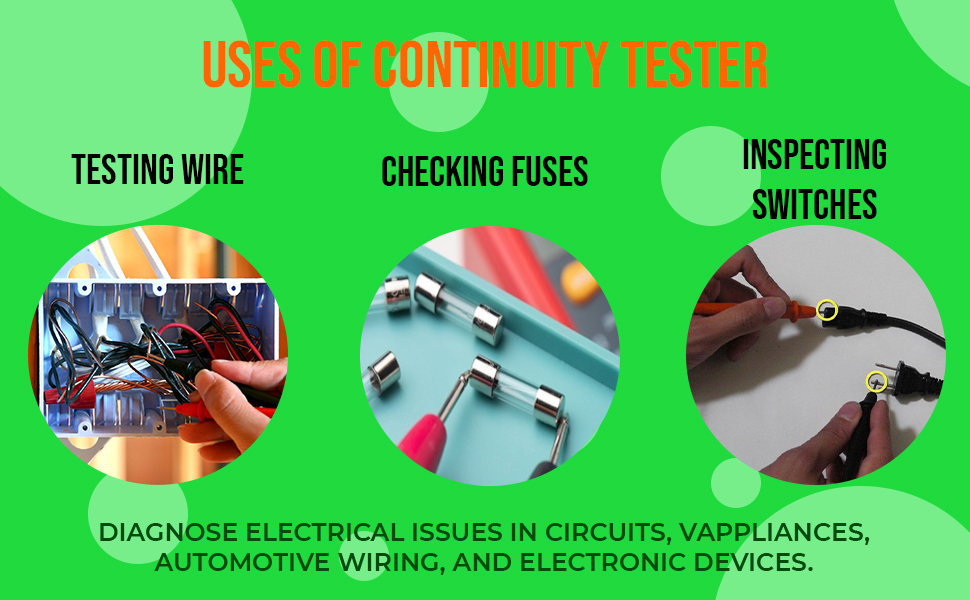
- Checking Wires and Cables: Identify if a wire is broken or intact inside insulation.
- Testing Switches: Ensure switches are functioning properly by verifying their ON/OFF connectivity.
- Inspecting Fuses: Quickly determine if a fuse is blown or still functional.
- Circuit Boards: Trace broken tracks or faulty connections in PCB projects.
- Household Repairs: Useful for checking sockets, extension boards, and small appliances.
- DIY Projects: Perfect for hobbyists working on electronics to verify circuit completion.
How to Use a Continuity Tester
- Turn on the tester (if required – in LED models, it activates automatically when connected).
- Connect the probes to both ends of the wire, fuse, or component being tested.
- If the red LED lights up, the circuit is complete.
- If no light appears, the connection is broken.
Why Every Electrician Needs One
- Quick Troubleshooting: Saves time by instantly showing connectivity.
- Easy to Use: No complex setup – ideal for beginners too.
- Portable: Small size makes it handy for both fieldwork and home use.
- Cost-Effective: Affordable but highly effective tool.
Final Thoughts
A continuity tester may be a small tool, but it plays a big role in electrical safety and troubleshooting. The Small Continuity Tester with Red Indicator LED Light and Pre Installed Battery from Vincentvolt ensures you have a reliable companion for detecting faulty connections and broken circuits with ease.
👉 Get your continuity tester today from Vincentvolt and make your electrical work safer, faster, and smarter.